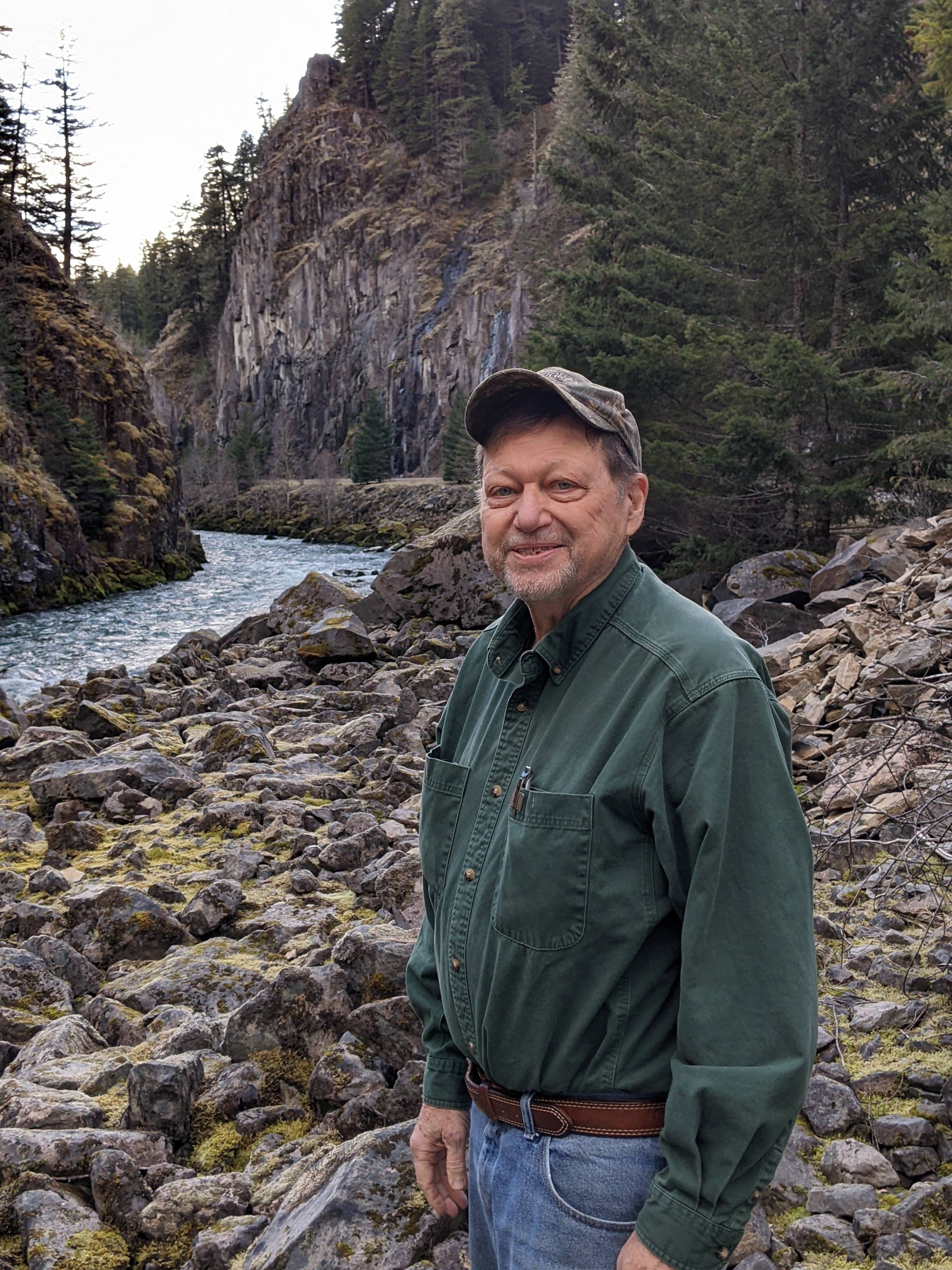
Interview by Lily Shaver. Edited for clarity.
On March 1, 2025 I interviewed Bill Shaver, who worked for the U.S. Forest Service for 36 years, from 1967 to 2003. Read all about his experiences living up the Clackamas River and growing up in Molalla.
- When were you first living near Estacada?
Near Estacada was when I moved away from the Marquam Molalla country, to where I started working in Ripplebrook. So that was the Winter of 1967. So I spent three months driving all the way from Marquam, all the way up to Ripplebrook, because I was a temporary employee, so there wasn’t any housing for me. So the commute, 60 miles one way, 120 miles round trip, on a road that was not in good condition. After the 1964 floods that wiped out roads going up to Ripplebrook and those places. So it was a very rough road, it was washed out in spots. They were reconditioning it, trying to make it travelable for us. Anyway, in late Spring of 1967, I got my full time position, so I was able to move my wife and my son Mark up to a spot they call the Silver Tip, which is an old logging community, put together by Silver Tip Logging Company.
So I lived there for maybe two years, in a little short trailer house, amongst other residents. Then moved from there when a house became available, down where the Job Corps is at, pretty close. The housing was once used by the Acme Lumber Company. It was houses they used for their employees when they had a saw mill there at Timber Lake. So we lived there for a handful of years. Underwent a major cold snap–the weather put down, pushing three foot of snow there. Froze everything solid for the most part. My neighbors house, just across the driveway from me–they were on vacation when this happened. I was supposed to be watching their place. I went over to check things out, and all the pipes were frozen. The little goldfish was at the bottom of its place, hardly moving or wiggling. They had left their bedroom window cracked so that their cat could get in and out. We had quite a bit of blowing from the storm, so the snow came in their window and coated their bed. And because it was so cold, it didn’t melt, it just laid there. They had pop bottles, which at that time was glass, not plastic. They had frozen solid and broke, so they were just crusty, broken ice chunks laying around. Anyway, it wasn’t a pretty picture.
There were several Forest Service people that lived in this little community, so there were seven or eight of us. So we’d get together for social times–because we were all Forest Service, we had a lot of stuff in common, we’d be working together up at the offices. So when it was Halloween time, Mark and Teri, my son and daughter would get their little bag there and get something from the federal employees, and dad would get a shot of bourbon or something like that from one of the neighbors.
During the snow, with basically three foot of snow on the ground and cold, it’s not melting–I at that time had a little Jeep Universal. I had it chained up, and we’d load as many people as we could in the back. Klunk, klunk, klunk, klunk, klunk. Up to the office–which was good for us to be able to work–nowadays they’d just shut down the office, but we kept going. And the sad part of the trip would be, that we’d come across deer standing on the road–they had no place to eat. So if they could get out of the deeper snow, and onto the road, they’d try to eat different vegetation and shrubs on the road, eat the twigs, kind of a thing. There was no use for us to try to put them back on the snow off the road. They just wouldn’t have made it. Many deer died that year. And that’s above elevation, so that’s where the cougar would come and do their feeding/eating. So it was just a sad time for the wildlife. The road is blocked beyond the Ranger Station, where you get the end of 224, across the Oak Grove Fork, there’s no snow plow out there or anything, just three plus foot of snow in the road.
Moved from Acme camp back up to Silver Tip, spent a few years there, in a house, a nice house, not a trailer. Had a good time there. Mark and Teri grew up for the most part there. We’d get maybe, annually about 16” of snow, we can handle the snow other than getting to Estacada and back for grocery shopping. It was a bummer having to chain up for the last three miles just to get to your house. Or to have to chain up to get out of your driveway to get up on the main highway. Broke a tire chain doing that, that was not fun. But we lived there for several years, and that was a good time.

The PGE’s pipeline went a couple hundred feet away from our house, so there was always the pipeline walker, the guy who’d walk it once a week, or whatever time period he was on there. Say “Hi” to him. The kids enjoyed the anthills, they had anthills that’d be three foot wide, and a foot and a half high or so. They enjoyed just walking around those, looking at the ants. A lot of wildflowers, great neighbors. We’d get together for picnics. I remember one of our trail workers, he played, it wasn’t an accordion, but something that pumps like those things. He’d sit there and sing songs for us. He was an older guy, so it was fun to watch that. We’d tell stories.
One of the people that lived up there was, well two of them, were the cooks for the summer crew. There were bunk houses there, so there were a number of summer temporary people that stayed there. And then one of the buildings was for the kitchen. So two ladies would put together meals for packing out, bring supper and breakfast. So that was a neat opportunity for the temporary people. Both of the husbands of the cooks worked for the Forest Service, so we’d get to see them out in the field sometimes. One of them was the guy who did the trail construction and maintenance. The other worked out in the fire warehouse. So anytime you wanted to borrow a tool out of the warehouse, be it a power saw or whatever, he would issue that out.
Then from Silver Tip, the Forest Service started building new homes and what you call the Township, the Ripplebrook Township, which is where all the dorms are, some of which have burned down in the last firestorms, but [we] moved down there, into a brand new house, pretty remarkable. The Ranger at that time was trying to get the community snuggled together, bring us in from all those temp areas or housing areas. So he got money to do the landscaping, and whatever else. So on the weekends and after work, we’d do landscaping with the plants that he bought. So we landscaped our own places. And that was good. Just kind of like generating your own homestead kind of thing. And it wasn’t just Colleen and I, it was other couples that felt the same way.

And there at the Ripplebrook area, Township area, we’d do the same thing, we’d have our group picnics. The ladies particularly would have volleyball games. They’d bring in people that would have house parties for trying on these type of clothes, and these kind of clothes, and how to make this kind of food and what have you. So that was entertainment and social for them. Our son Mark got to be old enough at that time to become a cub scout. So my wife Colleen was the cub scout master, so she had a handful of kids in the neighborhood there in Three Lynx that would do scouts, and some of the dads got involved. So anyway the cub scouts, it wasn’t like they were marooned from having activities, we’d take them out on camp outs. We’d take them to show them the places up there that were of significance like the powerhouse at Three Lynx, [they] got a tour through that. Took them down to the North Fork Reservoir, which at that time had an active fish ladder, maybe still does. And the PGE person gave us a tour through that, which was entertaining for all of us. And a camp out up at Timothy Lake, a camp out up at Round Lake, all good times. And we’d try to show the kids some skills during those exercises.
One of the things we’d do for the communities, regardless of which one we were living in, was we’d go to the Three Lynx grade school for a lot of activities, that was a core spot for activities. So there was an event that the school kids were putting on for some holiday. Different holidays we’d get down there, you know, there’s Valentine’s Day and Halloween, we’d have a get together with the kids doing their things there. So that was wonderful. We’d have potlucks down there when it was foul weather, get inside, and the school was very kind to let us get in there and do stuff. Three Lynx was really, like I say, a hub for the location, from before I ever moved up there, in ‘67. I heard a story of when the road was washed out in the ‘64 flood, people up there were isolated. They couldn’t go down the river, because the road was out, and they couldn’t go up over the mountains through Timothy and that initially, because of snow. So the residents would rally together with whatever food they had, they’d prepare it and meet at Three Lynx, and they’d have meals. A neat experience for everybody.
So then from Ripplebrook housing, it ended up, because Three Lynx school got shut down or was getting in the process of being shut down financially from the Estacada School District, Colleen and I were not going to have our son and daughter ride up and down this twenty some miles on a rough, bang, bang, road, (Hwy 224) on the school bus. So we moved on down to Estacada within the city limits. Paid way too much for an old house that had just been moved to the location. So we fixed it up and lived in it.
We were within walking distance of our church, the baptist church at that time. So we could walk over to there, the whole family. And being pretty close to the church, our house became a getaway for the high school aged kids who were going to the church. So we had whatever day of the week that we’d all be there and do their games and Bible study stuff, what have you together. So, what happened after that? At that time I was still working for the Forest Service–I was driving up and down the river for a while, from there. And then I got a job with the forest headquarters. At that time it was down on Division, in Gresham. I’d drive from Estacada to there. Spent two or three years there, then the forest built the new headquarters out in Sandy. So I was one of the first brand new residents of that new building. And I worked there until my retirement. And my retirement was in 2003.
2. I remember my Dad saying he watched Star Wars in the old theater on Broadway Street in Estacada. Do you remember the theater?
That’s right. Estacada had a downtown theater. The lower seating had been blocked off, but there was the upstairs part, and you could go up there and watch this program. Yep, there wasn’t a big crowd. You could hear the vibes coming when the Jedi or whatever came, the building kind of shaking a little bit. We went there a couple other times with neighbors. And I don’t remember when the Forest Service offices just below the theater closed. They ended up moving over to a brand new complex, the other side of town. [To where the Community Center is now.]
3. Do you remember the grocery store that you would go to in Estacada?
Would go to Cain’s or something like that. It was kind of next to Trail’s Inn. We’d go there. I don’t remember when they opened up the new one. And we would get our food there. I was trying to think whether we drove on into Sandy or wherever, but I don’t think we really did, because there weren’t any better options at that time as far as grocery shopping went.
4. Do you remember where you would get your ice cream?
Probably the same grocery store. There was a A&W outside of town. We’d go out there sometimes to have a burger or whatever, milkshake. And that didn’t last too long after we were there.

5. When did you first meet your wife?
I met my wife Colleen when we were going to high school in Molalla. She was a senior and I was a junior. So that’s kind of when we met each other. We had common friends who were juniors with me, (well, some with her too). But these common friends…she lived in Marquam, which is toward Silverton from Molalla, and these two friends also lived in Marquam, so we had justification for getting together, trying to win her over or whatever. And we’d do things together too as that pair, their sister and son–they had a pretty good size family. And we’d go on hikes to different spots, and one of the hikes was up to Lookout, I think they called it Lookout Mountain, and Butte Creek, we did that in the snow –exciting trip, with the Butte Creek falls. Golley Creek which is up above Molalla a ways past where my folks lived. We’d go fishing together.
6. What was it like growing up in Molalla?
Molalla was a good town. At that time it was anyway, I have no idea what it’s like now. I went through Molalla grade school. The initial grade school was the original Molalla grade school. It’s gone now. That’s where my brothers and my Dad also went, everybody in town went to school [there]. I started first grade there. Before I got to second grade, they had a brand new grade school outside of town. So for the most part, my Dad would give me a lift to Molalla, and then I’d walk from Molalla on out to the grade school. We’d walk back and get a ride home. I think at that time, Dad was working as a custodian at the high school, so that’s where I’d get in and out of town. Graduated from the grade school–first graduating eighth grade class from the grade school. Moved into the high school right there in town. The current one is outside of town, but it was the original building. Spent all four years there, so got to make a lot of friends. We had a group called “The Good Buddy Group.” There were three or four of us, maybe five of us. I think we were all seniors, in the same class going through school anyway. So we always introduced or said “Hi” to each other as “Good Buddy.”
“Hi good buddy!” And one of those good buddies ended up being my best man at my wedding. He’s gone now, but he was a good buddy. So that was my school years.
7. What was it like growing up on a farm?
My parents owned an 80 acre farm about three miles outside of Molalla going South. When I was just a little toddler, my Dad was still an active farmer. So we had all the things that a farmer of the ‘50s should have at that time, trying to keep afloat. So we had grain and wheat crops, pigs, turkeys, chickens, did I say sheep yet? We had like a hundred head of sheep. We’d keep them for the wool of course, and the meat. We had milk cows. We had a big garden, and canned food out of the garden. We had deer on the property, so during the season we’d have deer to pack and put away. During that era, we just had a little bitty culinary refrigerator. Freezers weren’t what you’d call “financially available” for us at that time. So all the frozen stuff would go down to a locker in Molalla, not just ours, but it belonged to the community. So you take your meat down there and have it frozen, and have your vegetables frozen. And you could pick up big blocks of ice to bring back to your house for whatever cooling you needed there. We made home-made ice cream, so that’s where the block of ice would come in. And we’d have picnics, like when we’d be harvesting the wool from the sheep, that often was maybe 600 feet from our house, fenced in area. So after the shearing time, all the neighbors would’ve come to help, and after the shearing we’d have a big picnic. Homemade ice cream! Wonderful stuff. I volunteered–no not really–to do the cranking of the ice cream. But it was worth it.
8. What was your favorite thing that your Mom would make growing up?
I liked everything she did, but one thing was, she’d make cobblers, because we had berries, blackberries. And she’d make apple crisp, because we had an apple orchard. I loved apple crisp. And we had Gravenstein apple trees there amongst all the other apple trees. So most of that was Gravenstein apples. My brothers and I would hike across the property–and we’re looking at 80 acres, so I don’t know what that is in a straight line across it, but it’s a ways, and we were picking berries over there–two of a different berry, and bringing them back, and she’d make cobblers out of that. Yeah, pretty yummy.

9. What was one of your favorite things about working for the Forest Service?
Being in the forest environment. Basically that’s it. Walking a lot of ground I hadn’t walked before. Seeing things that you can’t see from the road, like the creeks and what have you, the wildflowers, just the nature of it all. I liked what I did, too. I did timber sale preparation, and designed the timber sale out in the woods, estimated the volume of the board feed in it and eventually made the timber contract. All the ground harvested needed to be regenerated with seedlings, and that would amount to almost 600,000 annually. I would administer those contracts.
I love the plants, and you get to see a variety of them and you got to watch their bud burst times (when the plants begin to flesh). I loved the fragrances that came with the vegetation. The blooming of a big patch of rhododendrum. I especially liked the fragrances during the fall season, when the huckleberries were out.
You’d start from 1,500 feet elevation where the Ranger Station (Ripplebrook) is at, and go up to 5,000 feet. So what was blooming at 1,500 feet was gone by the time you got up another elevation level. So get up high and you get into the upper mountain, upper elevation plants. I could predict by certain spots, because I travelled through them all the time–when a particular flower was blooming, I could tell you what particular time of year it was. For the tree planting, the campers and the planters would camp in a certain spot. And I could just tell by what was blooming there when we ought to shut down the tree planting operation.
8 responses to “THE ESTACADA CITIZEN FOCUS: BILL SHAVER Q&A”
I found this heartfelt story by accident. Thanks for sharing.
Great life story. My husband remembers Bill from those 70-80 years at the forest service.
Keep bringing the History about our little town to life Lily. Good work.
Thank you Sandy!
Great job Lily, I love hearing dad’s stories. Great interview about an amazing man💛
Thanks Aunt Teri! ☺️🙂
What a wonderful and sweet interview.
Very well done.
Thank you, Karena!
Wow, so cool to read about Grandpa’s life growing up and working and living in Estacada.